

no. 9
Essay, January 2026, about 4 min
The Neighbour Principle at Ninety: Donoghue v Stevenson and the Law It Made
A Reflection on How a Snail in a Bottle Became the Foundation of Modern Tort Law
By Huzaifa Ahmed
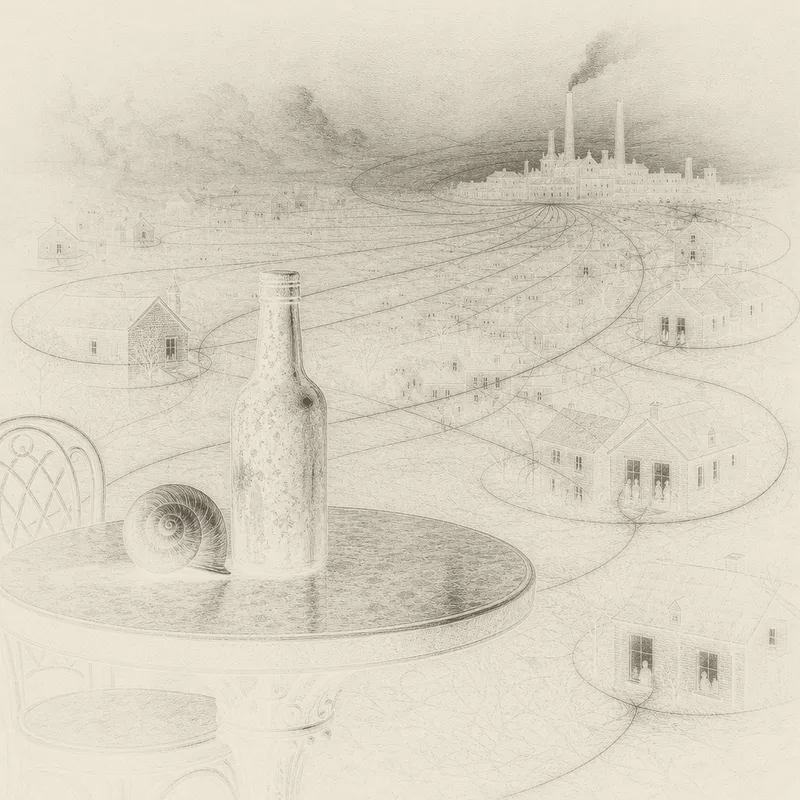

The facts of Donoghue v Stevenson are so well known to law students that they carry the slight unreality of legend. A woman drinks ginger beer from an opaque bottle. A decomposed snail emerges. She suffers gastroenteritis and nervous shock. She sues the manufacturer. The House of Lords, by a majority of three to two, holds that she can. Lord Atkin formulates what he calls the neighbour principle. Ninety years later, every first-year law student in the country can recite it, and the English law of negligence still rests upon it.
Before 1932, the position of a plaintiff in Mrs Donoghue's situation was bleak. The general rule was that a manufacturer owed no duty of care to the ultimate consumer of a product where there was no contractual relationship between them. The exceptions, recognised in cases such as George v Skivington (1869) LR 5 Ex 1, were narrow and uncertain. The doctrine of privity of contract operated as a barrier to recovery in tort, and the absence of a general duty of care meant that the law of negligence was a patchwork of specific duties recognised in particular circumstances.
Lord Atkin's speech changed the structure of the inquiry. The question was no longer whether the case fell within an established category of duty, but whether the relationship between the parties was such that a duty arose. The neighbour principle, drawn from the parable of the Good Samaritan and reframed in legal terms, provided the test: a person must take reasonable care to avoid acts or omissions which they can reasonably foresee would be likely to injure their neighbour. Neighbour was defined as those persons who are so closely and directly affected by the act that the defendant ought reasonably to have them in contemplation when directing their mind to the acts or omissions in question.
The principle was, in 1932, more aspiration than rule. Lord Atkin's speech is a remarkable piece of judicial writing precisely because it reaches for a generalisation at a moment when the technical disposal of the case did not require one. The decision in Donoghue itself was narrow: a manufacturer of products which they intend to reach the ultimate consumer in the form in which they leave them, with no reasonable possibility of intermediate examination, owes a duty to that consumer to take reasonable care. The neighbour principle was, in formal terms, obiter dictum. It was the obiter that became the law.
The development of the duty of care since Donoghue is a history of courts trying to contain what Lord Atkin set in motion without abandoning its essential insight. The expansion of the principle in Anns v Merton London Borough Council [1978] AC 728, which adopted a two-stage test that began with the neighbour principle and asked whether there were any considerations that ought to negate or limit the duty, was followed by a contraction in cases including Murphy v Brentwood District Council [1991] 1 AC 398, which overruled Anns and reinstated the requirement that the imposition of a duty of care be justified on the facts of each category of case.
The Caparo Industries plc v Dickman [1990] 2 AC 605 three-stage test, which requires foreseeability, proximity, and that it be fair, just and reasonable to impose a duty, has structured the inquiry for the past three decades. The Supreme Court in Robinson v Chief Constable of West Yorkshire Police [2018] UKSC 4 has more recently reframed the inquiry in incremental terms, observing that Caparo did not create a free-standing test to be applied across the board, but a structure within which the law of negligence develops by reasoned analogy from established categories.
The neighbour principle's lasting achievement was not a rule but a disposition: the recognition that the law of obligations should not be a closed system of forms but an open structure of principle. The English law of negligence remains, ninety years after Donoghue, an attempt to give institutional shape to that disposition. The history of the duty of care since 1932 is the history of that attempt, and there is no reason to think that the attempt is complete.
Conclusion
Ninety years after Donoghue v Stevenson, the neighbour principle remains the conceptual root of the modern law of negligence, even as the structure that has grown from it has become more complex than Lord Atkin can have foreseen. The successive recalibrations of the duty of care, from Anns through Murphy to Caparo and now to Robinson v Chief Constable of West Yorkshire Police, have refined and at times retreated from the breadth of the neighbour principle, but have not abandoned it. The disposition Lord Atkin announced, that the law of obligations should respond to the moral logic of human relations rather than to the closed forms of an earlier age, has shaped tort law for almost a century.
The lasting achievement of the case is not the particular rule it produced but the orientation it established. Donoghue v Stevenson taught the common law to ask, in any new situation, whether reasonable foresight and proximity supported the existence of a duty, and to give a principled rather than a merely formal answer. That orientation continues to guide the development of the law in fields the original case could not have contemplated, from psychiatric injury to economic loss to the emerging doctrines around digital harms. The neighbour principle endures because it described not a rule but a method, and the method remains the right one.